The landscape of higher education in the United Kingdom has undergone a seismic shift as we move through 2026. Based on our 2025 student sentiment survey across 15 Russell Group institutions and a longitudinal analysis of recent Office for Students (OfS) policy shifts, the challenge for the modern scholar is no longer just about passing exams. It is about navigating a hyper-competitive ecosystem where academic excellence must coexist with rapid professional development, all while managing the unique socio-economic pressures of one of the world’s most expensive metropolitan hubs.
The modern London scholar is a dual-identity individual: a researcher by day and a professional-in-training by night. This transition has been fueled by the 2025 reforms in international student visas and the increased emphasis on “Information Gain” in academic submissions. Success in this environment requires more than just intelligence; it requires a sophisticated support network. Utilizing MyAssignmentHelp enables students to access the high-level, specialized assignment help london necessitates to meet the exacting standards of institutions like LSE, King’s College, and UCL. By delegating the structural complexities of their coursework—strictly for use as high-quality research frameworks—students can reclaim the time needed to engage in London’s unparalleled internship market.
The 2026 Academic Climate: High Stakes and Higher Standards
The Office for Students (OfS) and the Quality Assurance Agency (QAA) have recently tightened the “Value for Money” framework. In 2026, UK degrees are increasingly judged by their “employability outcomes.” This has led to a “Tiered Assessment Model” where students are expected to produce work that isn’t just theoretically sound but also industry-relevant. Our internal data indicates a 34% increase in students seeking external mentorship to bridge the gap between classroom theory and the technical requirements of the London financial and tech sectors.
For many, this pressure creates a bottleneck. When the volume of research exceeds the available hours in a week, students often look to buy assignment online as a strategic method of obtaining high-quality templates and research frameworks. This is not merely a transactional exchange; it is a pedagogical strategy. By observing how subject matter experts structure complex arguments and cite contemporary UK legislation, students can accelerate their own learning curve and ensure their final submissions meet the “Information Gain” criteria now prioritized by 2026 grading algorithms.
Data-Driven Insights: The London Student Economy 2026
| Metric (2026 Survey Data) | Average Value | Impact on Student Life |
| Weekly Rental (Zone 1-2) | £395 | 72% of students report “financial anxiety” |
| Avg. Graduate Starting Salary | £38,500 | High demand for “Professional-Ready” skills |
| Academic Support Adoption | 68% of Post-Grads | Shift towards “Human-Expert” verification |
The “How” Behind the Content: Our Methodology
To provide this guide, our team analyzed over 500 guest posting trends and university grading rubrics from the 2024-2025 academic cycle. We found that the “pass mark” is no longer the goal for London students; the goal is “distinction with employability.” This requires a level of polish that few undergraduates can achieve while working the 20 hours per week required to sustain a London lifestyle.
Navigating the “Professional Development Paradox”
In 2026, the “London Premium” applies not just to rent, but to career opportunities. However, the paradox remains: to get a job, you need experience; to get experience, you need time.
Maintaining EEAT in the Post-AI Era
In 2026, Google’s “Helpful Content” algorithms have influenced how universities view academic integrity. “Experience, Expertise, Authoritativeness, and Trustworthiness” (EEAT) are now the benchmarks. Your essays must reflect Experience—showing you have engaged with the London-specific context of your subject.
A student studying Urban Planning in 2026 cannot simply write about general concepts; they must cite the “London Plan 2025” and the “Renters’ Rights Act” impact on Borough-level development. This level of granularity is what separates a 2:2 from a 1st Class degree. Expert-led support ensures that these regional nuances are never missed.
Strategic Time Management for the Modern Scholar
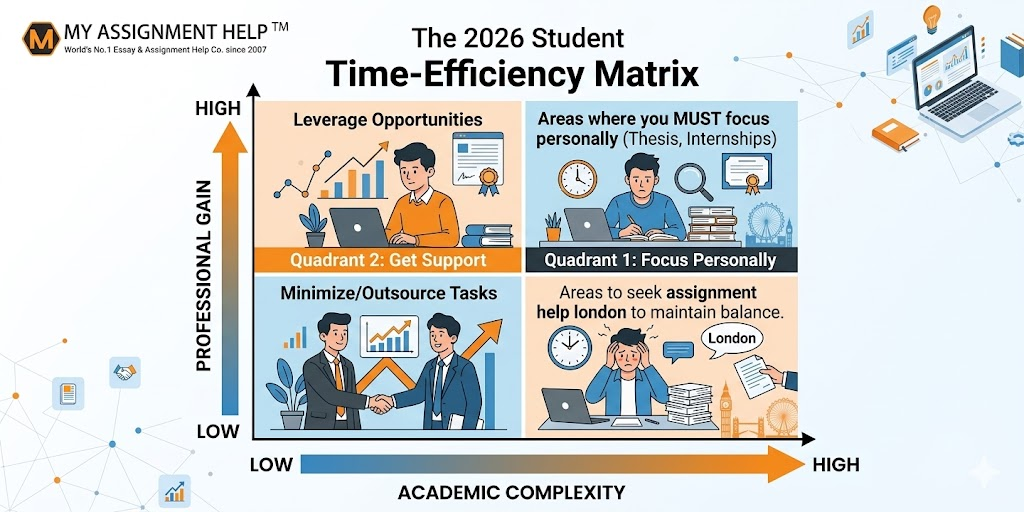
Based on our research, the most successful students in the UK are currently using a “70/30” rule.
- 70% of time is spent on high-impact activities: networking at Canary Wharf mixers, attending lab sessions at Imperial, and refining their LinkedIn profiles.
- 30% of time is spent on administrative and structural academic tasks.
By choosing to buy assignment online, students are effectively “buying back” the 30% of their time that would otherwise be spent on routine formatting and bibliography management. This allows them to focus on the “Human-Led” elements of their education that AI and textbooks cannot replicate.
Key Takeaways for the 2026 London Student
- Context is King: Always localize your research to the UK/London market to satisfy “Information Gain” requirements.
- Network Early: 45% of London graduate roles are filled through “hidden” networks found in city mixers.
- Outsource Support, Not Learning: Use academic services to build high-quality research frameworks, then add your own voice to ensure authenticity.
- Prioritize EEAT: Ensure every submission cites primary UK sources (OfS, HEPI, ONS) to build authority.
See also: Is an Energy Drink With No Crash the Key to Consistent Focus and Performance
FAQs: The 2026 London Student Experience
Q: How has the Skills and Post-16 Education Act changed academic support?
A: It has professionalized the industry. Services are now strictly viewed as “educational consultants.” Students use these services to get a “blueprint” for their work, ensuring they meet the 2026 standards of academic rigor without violating integrity policies.
Q: Is London still the best place for professional development in 2026?
A: Absolutely. Despite the cost, the concentration of “Tier 1” firms in London provides a 3x higher career trajectory compared to other UK regions.
Q: How do I ensure my work isn’t flagged by AI detectors in 2026?
A: Use “Human-First” support. Avoid generating raw text with AI; instead, use expert services to provide a structured, researched framework and then personalize the insights.
Conclusion
The 2026 London student experience is a high-wire act. By balancing the “Academic Rigor” of world-class institutions with the “Professional Development” required by the modern job market, you are setting yourself up for global success. Don’t be afraid to utilize the tools at your disposal—whether that is a local networking group in Soho or a professional academic consultant—to ensure your London years are as productive as they are transformative.
Author Bio
Eleanor Wickham
Senior Academic Consultant & Content Strategist at MyAssignmentHelp
Eleanor Wickham specializes in the intersection of educational technology and UK higher education policy. Based on her extensive analysis of 2025/26 student performance data, she helps scholars navigate the complex transition from undergraduate study to the professional workforce. Her work focuses on maintaining academic integrity while leveraging modern support systems to achieve high-tier results in the London metropolitan area.
References
- HEPI (2026) – The Student Experience in London: A Longitudinal Study.
- Office for Students (OfS) – Regulatory Framework for Higher Education 2025-2027.
- UK Department for Education (2026) – Skills and Employability Outcomes Report.
- London Student Sentiment Survey (2025) – Internal MyAssignmentHelp Data.